[Skip to content](https://www.t-mobile.com/news/network/whats-next-for-bead#maincontent)
[Newsroom](https://www.t-mobile.com/news)Toggle secondary navigation
- [Network](https://www.t-mobile.com/news/category/network)
- [Devices](https://www.t-mobile.com/news/category/devices)
- [Un-carrier](https://www.t-mobile.com/news/category/un-carrier)
- [Community](https://www.t-mobile.com/news/category/community)
- [Offers](https://www.t-mobile.com/news/category/offers)
- [Business](https://www.t-mobile.com/news/category/business)
English
[NetworkCategory](https://www.t-mobile.com/news/category/network)[Blog](https://www.t-mobile.com/news/blog)
# Finish the Job: Building on BEAD’s Success to Get America Connected
By John Saw, President & CTO, T-MobileMarch 02, 2026
[Arrow Right Icon](https://www.t-mobile.com/news/_admin/uploads/2026/02/PolitcoPiecePic_280x640.jpg)
4 min readListen IconListen
Listen to this article
0:00
- Facebook IconShare on Facebook
- Share on Twitter
- LinkedIn IconShare on LinkedIn
The United States has made tangible progress connecting homes to high-speed internet, yet there are still gaps to be filled. BEAD, the [Broadband Equity, Access and Deployment Program](https://www.ntia.gov/funding-programs/high-speed-internet-programs/broadband-equity-access-and-deployment-bead-program), was created to make sure every American has reliable broadband, especially in underserved or unserved communities. Thanks to the U.S. Department of Commerce’s National Telecommunications and Information Administration ([NTIA)](https://www.ntia.gov/), which oversees the $42.5 billion BEAD program, and strong state execution, momentum is real.
And as more homes gain connectivity, BEAD has a chance to finish the job by closing the last gap: In too many rural communities, service drops the moment people walk out their door. These mobile dead zones are not just inconvenient. They hold back local economies, create real safety risks and maintain the digital divide, even as BEAD makes historic strides on in-home access.
BEAD offers the opportunity to permanently close both mobile and remaining in-home service inequities. The state of Louisiana, for instance, through [ConnectLA](https://connect.la.gov/), is using this program to deliver high-speed broadband to every resident — while saving taxpayers more than $850 million through BEAD funding.
As part of the Louisiana Local Fiber Consortium, T‑Mobile will help bring America’s Best Mobile Network to more than 66,000 locations, cutting the state’s mobile coverage gaps in half. Louisiana has shown what’s possible, and it offers a strong, practical model.
## __A Tipping Point__
In December 2025, NTIA shared that its [Benefit of the Bargain state application](https://www.ntia.gov/press-release/2025/trump-administration-announces-benefit-bargain-bead-program-removes-regulatory-burdens-lowers-costs) process [saved taxpayers $21 billion](https://www.ntia.gov/press-release/2026/assistant-secretary-arielle-roth-announces-50-bead-final-proposals-approved). That’s a big win and a strong sign the program is being managed effectively. Now, Administrator Arielle Roth and NTIA are asking, “How will we use these savings?”
__Original BEAD funding = $42.5 billion__
__After Benefit of the Bargain process = $21 billion savings for American Taxpayers__
## __Smart Decision-Making__
Once home internet needs are met, NTIA can empower states to leverage remaining BEAD dollars to close rural mobile dead zones, extending BEAD’s impact for the communities it was designed to serve. That fits directly within BEAD’s mission to support scalable, next-generation infrastructure, and it aligns with NTIA’s focus on long-term value including today’s 5G, tomorrow’s 6G and AI adoption. And as the nationwide leader in 5G, T‑Mobile is using [AI-powered 5G Advanced](https://www.t-mobile.com/how-mobile-works/innovation/5g-advanced) to set the path toward [6G with AI-RAN](https://www.t-mobile.com/how-mobile-works/innovation/ai-ran-and-6g).
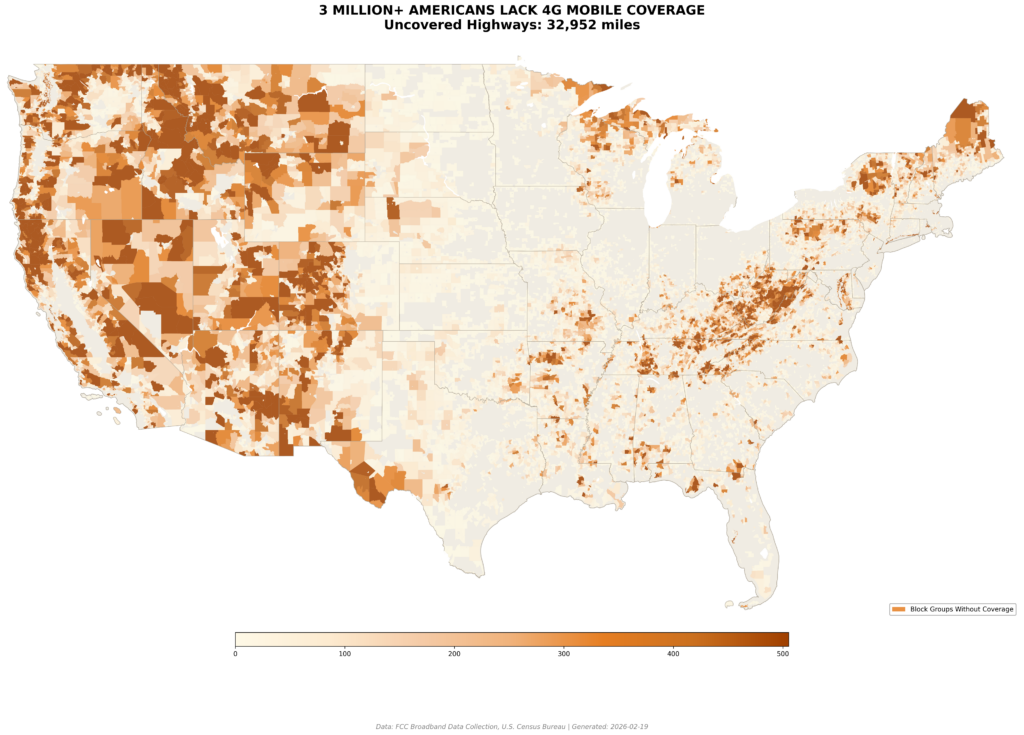
Mobile connectivity is critical to how people live and work today. It keeps businesses running, students learning, farms productive, commercial drivers connected and first responders reachable. In rural America, reliable mobile service is not a bonus. It is a basic need. And yet, there are still coverage gaps where over 3 million Americans still lack even 4G connectivity. To get ahead, we can’t leave people behind.
[Arrow Right Icon](https://www.t-mobile.com/news/_admin/uploads/2026/03/nationwide_coverage_gaps_map_20260219_114256.png)
With the momentum NTIA has built through BEAD, we can get there. Our analysis shows that about 6,000 more mobile macro sites could extend 5G coverage to roughly 99% of Americans, including key rural roads.
__About 6,000 new mobile macro sites and roughly $8 billion could deliver 5G__
__coverage to about 99% of the U.S. population for the next decade.__
That is why we propose a disciplined approach: allow targeted mobile funding under BEAD, capped at around $8 billion. Upwards of $13 billion in funding will remain once these defined coverage benchmarks are achieved. Build what is needed, deliver the coverage and then step back. That is what responsible stewardship looks like.
BEAD has already transformed fixed wireless access nationwide, thanks to strong leadership from the Department of Commerce and NTIA. With the same disciplined approach to mobile infrastructure, it can finish the job on connecting underserved areas. This isn’t about expanding the program. It’s about finishing it.
Closing remote mobile gaps delivers real benefits, from jobs and stronger public safety to more resilient communities in times of crisis. Most importantly, it gives Americans in rural areas the reliable service they need.
T‑Mobile’s mission is to be the best in the world at connecting our customers to their world. Let’s keep working to get rural America fully connected, at home and on the move.
Tags[Community](https://www.t-mobile.com/news/archive/community)[Government Affairs](https://www.t-mobile.com/news/archive/government-affairs)[Network](https://www.t-mobile.com/news/archive/network)
## Related Stories
[More Stories](https://www.t-mobile.com/news/category/network)
[
\
NetworkPress Release
\
__T‑Mobile Strengthens California’s Emergency Preparedness with Expanded 5G Access at 11 Rural County Fairgrounds__
\
October 25, 2024|4 min read](https://www.t-mobile.com/news/network/t-mobile-strengthens-californias-emergency-preparedness-with-expanded-5g-access-at-11-rural-county-fairgrounds)
[
\
CommunityStory
\
__The Affordable Connectivity Program Is Ending — T‑Mobile Has Options to Keep You Connected__
\
April 15, 2024|3 min read](https://www.t-mobile.com/news/community/the-affordable-connectivity-program-is-ending-t-mobile-has-options-to-keep-you-connected)
[
\
CommunityPress Release
\
__T‑Mobile Contributes $1 Million to Smithsonian’s New Exhibition on the Impact of Wireless Connectivity__
\
March 22, 2023|4 min read](https://www.t-mobile.com/news/community/t-mobile-contributes-1-million-to-the-smithsonians-new-exhibition)
[
\
CommunityBlog
\
__We’ve Made Great Progress in Delivering Connectivity to Underserved Students. And as the Urgency Increases, We Won’t Stop.__
\
September 21, 2022|5 min read](https://www.t-mobile.com/news/community/project-10million-fall2022-update)