[Skip to content](https://www.t-mobile.com/news/network/physical-ai-is-leaving-the-lab#maincontent)
[Newsroom](https://www.t-mobile.com/news)Toggle secondary navigation
- [Network](https://www.t-mobile.com/news/category/network)
- [Devices](https://www.t-mobile.com/news/category/devices)
- [Un-carrier](https://www.t-mobile.com/news/category/un-carrier)
- [Community](https://www.t-mobile.com/news/category/community)
- [Offers](https://www.t-mobile.com/news/category/offers)
- [Business](https://www.t-mobile.com/news/category/business)
English
[NetworkCategory](https://www.t-mobile.com/news/category/network)[Blog](https://www.t-mobile.com/news/blog)
# Physical AI Is Leaving the Lab
October 27, 2026
By John Saw, Chief Technology Officer, T‑Mobile
[Arrow Right Icon](https://www.t-mobile.com/news/_admin/uploads/2026/10/Figure-AI-Robot_2_1280x640.png)
10 min read
- Facebook IconShare on Facebook
- X IconShare on Twitter
- LinkedIn IconShare on LinkedIn
The past few years, AI has become astonishingly good at what happens on a screen. It writes, reasons, and generates. Now we’re asking for something much harder: move, reason, and take action. Unlike a screen, the physical world doesn’t pause while you think. People step into the path, objects shift, lighting changes, surfaces behave differently than expected. The environment is in constant motion, and AI must be in motion with it.
A humanoid learns a task and applies it to a new environment. An autonomous delivery robot navigates a crowded sidewalk. A camera becomes part of a system that understands an entire city’s traffic. A drone inspects infrastructure after a storm and helps technicians identify places that need attention first.
These are all examples of why physical AI is so compelling. It gives intelligence a way to participate in our world, not just describe it.
Earlier this year, I wrote that [intelligent networks will become the nervous system](https://www.t-mobile.com/news/network/why-physical-ai-begins-with-intelligent-networks) for this connected world. What felt like an architectural idea is becoming much more tangible. Developers are now bringing vision and reasoning models to T‑Mobile’s network edge infrastructure, putting AI closer to the machines, cameras and sensors that depend on it.
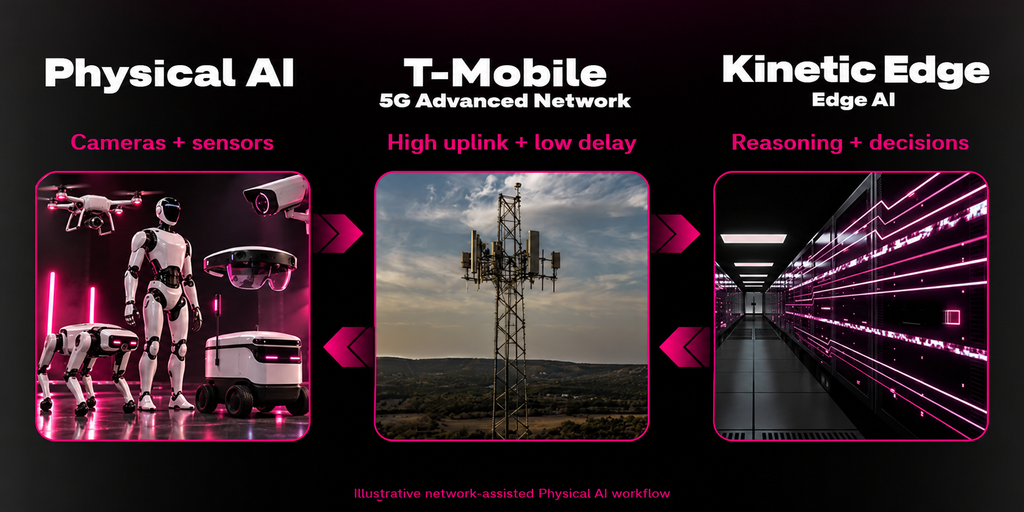
That shift points to something bigger. Physical AI can’t only rely on a distant cloud. Machines need to see, reason and act in real time, which means intelligence often needs to be distributed closer to where the work happens. Edge inferencing, supported by advanced connectivity and distributed infrastructure, can help make that possible. That’s why T‑Mobile is working with key partners to develop architecture that connects intelligence to real machines, real environments, and real-world challenges.
But physical AI isn’t about a machine accomplishing a remarkable task once. The bigger challenge is making that intelligence useful, reliable and available wherever machines operate.
Wi-Fi and satellite will both play a role in this connected future, but neither can deliver the consistency, reliability, real-time inferencing and advanced deterministic connectivity that physical AI demands. As intelligent machines move through cities, across industries and between environments, connectivity must do more than simply keep them connected. These machines need to continuously share what they see and sense, access intelligence in real time and respond with minimal delay. That requires seamless mobility, high-capacity uplink, low latency and wide-area coverage that advanced terrestrial wireless networks are uniquely positioned to support.
This is where T‑Mobile’s nationwide 5G Advanced network, together with distributed edge infrastructure, creates a differentiated opportunity. By bringing connectivity and intelligence closer to where machines operate, we can help make physical AI more responsive, reliable and scalable — moving beyond impressive demonstrations to real-world impact.
__Smarter Machines Don’t Have to Carry Intelligence Alone__
You can make a model bigger and a robot smarter. But the robot still has to carry its own batteries, shed its own heat and fit through a doorway. Past a certain point, more onboard intelligence means tradeoffs in power, weight, cost and run time.
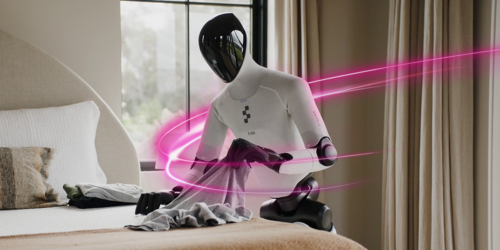
This is where T‑Mobile’s advanced, distributed 5G network comes into play, creating opportunities to move intelligence beyond the robot itself and into the network. It’s also why our work with [Figure AI](https://www.figure.ai/) matters strategically.
It began with connectivity: eSIM service for Figure AI’s humanoid robots. Now we are evaluating the next layer: inference and intelligence at the network edge. Together with Figure, we are assessing whether portions of the Helix S1 and S2 models can run on compute closer to the edge while preserving the responsiveness machines in the physical world require.
What matters is the progression and the real-world proof that it’s working. We connected the robot. Then we helped enable the training loop. Now we are testing how the network can best help deliver the intelligence itself.
For T‑Mobile, that is the larger opportunity with physical AI. As AI moves into robots, vehicles, cameras and other machines, connectivity, compute and intelligence can increasingly come together across a distributed network. For robots, that could mean access to more capable AI without proportionally more power, weight or hardware onboard and for us, it expands the role the network can play in scaling physical AI.
It also changes the question. Instead of asking how much intelligence can fit inside a robot (which will always be limited), we can ask how much intelligence the network can make available to it, wherever it operates and whenever the work demands it. That is how our role is evolving: from connecting physical AI to helping scale the intelligence that powers it.
__Scale Changes the Shape of the Problem__
The same shift appears when one intelligent machine becomes a fleet.
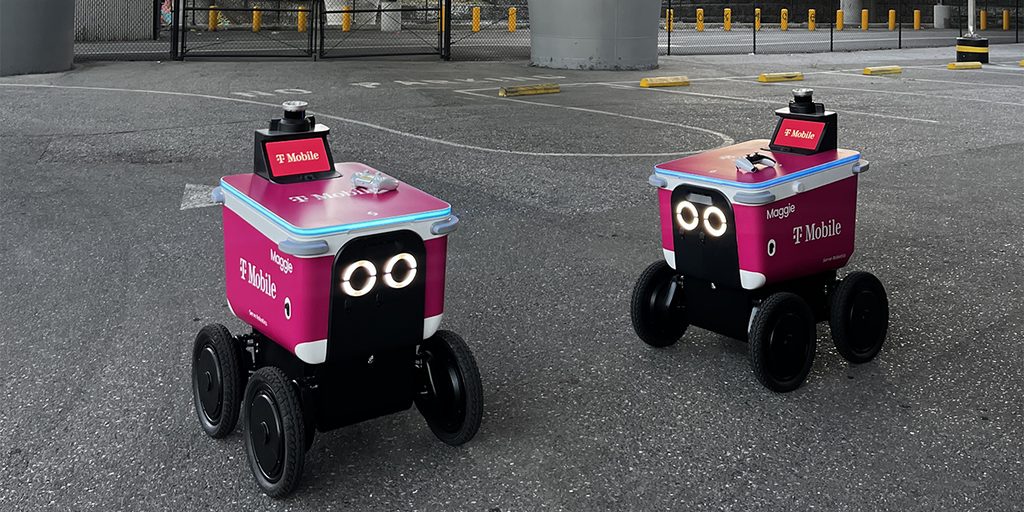
That’s why we’re partnering with [Serve Robotics](https://www.serverobotics.com/). Sidewalk delivery robots spend their days in the untidy, edge cases of the real world: a construction barrier that wasn’t there yesterday, a dog off its leash, a scooter blocking a curb. With a handful of robots, a technician can step in as needed. With thousands, human attention becomes the bottleneck and can be the deciding factor whether the fleet is worth the investment at all.
[](https://www.serverobotics.com/)[Arrow Right Icon](https://www.t-mobile.com/news/_admin/uploads/2026/10/Serve-Robotics_Maggie_1280x640.jpg)
An AI supervision layer at the edge could separate the moments that truly need human interaction from those that simply need a more powerful AI to resolve. Humans would provide guidance in the most complex scenarios, and robotic fleets can scale faster using increasingly powerful and distributed AI.
We are also collaborating on edge-powered conversational AI that could give Serve’s robots more natural ways to interact with people, without requiring more onboard AI processing.
The opportunity is the same in both cases: move the attention to the problem from each individual robot and into a shared layer of intelligence, so the fleet can scale without needing human oversight to scale at the same rate.
__A City Is a Robot, Too__
T‑Mobile is working with the [City of San Jose](https://www.sanjoseca.gov/), [LinkerVision](https://www.linkervision.com/) and [Laplace Intelligence](https://www.laplaceintelligence.com/) to explore how 5G-connected cameras and edge AI can turn individual views into a broader understanding of traffic across the city.
One camera shows what’s happening at a single intersection. Connect many cameras to AI that can reason about the environment, and the system can begin to see how events relate to one another across streets and corridors. That helps people spot patterns sooner and respond with better context.
__The Network Is Becoming Part of the AI Architecture__
Figure AI, Serve Robotics and City of San Jose are different applications of the same strategy. Physical AI needs intelligence in more than one place, and the network connects them into a cohesive working system.
Intelligence will live on the device, at the edge and in the cloud. Our job as a connectivity provider is to make each layer work together, so data and workloads are where intelligence needs to run, at a speed the physical world requires.
To enable all these use cases, we are partnering with Amazon Web Services (AWS) to build the first instances of our Kinetic Edge, our distributed intelligence infrastructure for Physical AI. By combining T‑Mobile’s nationwide 5G Advanced network and distributed edge with AWS’s cloud orchestration and AI services, we are bringing deterministic connectivity, compute and intelligence closer to where machines operate. This enables enterprises to move physical AI from isolated demos to real-world deployment at scale.
__Building the AI-RAN Foundation for Physical AI__ __and 6G__
Through our partnerships with NVIDIA and Nokia, and with Ericsson, T‑Mobile is exploring how AI and network workloads can share accelerated computing infrastructure. And we’ve already hit a major AI-RAN milestone in October 2026: completing the world’s first AI-RAN call on a commercial network with Nokia and NVIDIA.
NVIDIA CEO Jensen Huang [highlighted in his GTC Berlin keynote](https://youtu.be/duQhkyiOHA8?si=ouEPPSnp55XJ9YdL), networks have the potential to become distributed AI infrastructure.
We see AI-RAN as an evolution, a continuum, not a single product or architecture. The immediate opportunity is a smarter, more efficient network. Looking ahead, 6G promises to do even more for physical AI. Today’s networks connect machines to AI. With integrated sensing and communications (ISAC), 6G networks will sense the physical world for them. The same radio signals that carry data can detect, locate and track objects, so the network doesn’t just carry data to physical AI, it becomes a sensor itself. That’s why the accelerated, programmable foundation we’re building with AI-RAN matters: sensing at national scale takes compute at the edge to turn raw signals into real-time awareness.
__And we have started to make progress toward 6G.__ In what we believe is the world’s first multivendor pre-6G trial, T‑Mobile, Ericsson and MediaTek are pushing the boundaries of wireless performance using 400 MHz channels in the 7 GHz spectrum band. It’s an encouraging first step on a larger journey to 6G, demonstrating the potential to achieve download speeds of more than 5 Gbps, upload speeds of more than 2 Gbps and ping latency as low as 4 milliseconds.
__Connect. Scale. Orchestrate.__
All of this comes together in what we are building: a network that connects, scales and orchestrates in the real world.
First, connect. Make it simple and seamless to bring intelligent machines onto the network, with the reliability and flexibility to support physical AI wherever it operates.
Next, scale. Give machines access to intelligence beyond what they can carry onboard, so their capabilities aren’t limited by processing power, battery life or physical size.
Finally, orchestrate. As physical AI evolves from individual machines into fleets navigating complex environments, it’s our job to enable networks, devices and computing resources to work together, bringing the right data, context and intelligence to the right place at the right time.
This is where years of investment in our network begin to compound. T‑Mobile pioneered the nation’s first nationwide 5G Standalone network, and today we have 5G Advanced nationwide. Capabilities like uplink performance, network slicing, programmability and distributed infrastructure are more than innovations. They’re the foundation for a world where intelligence must move, adapt and act in real time
[Arrow Right Icon](https://www.t-mobile.com/news/_admin/uploads/2026/10/Physical-AI-to-Kinetic-Edge-1.png)
This early work is helping us explore the capabilities that could make Physical AI possible at scale, while opening the door to entirely new applications and opportunities.
Our ambition is simple: to make every new physical AI application easier to connect, scale and orchestrate than before.
__The Lab Was Never the Destination__
There is still a great deal to build. Physical AI is in its early days. Architecture will evolve, new possibilities will emerge, and some of the most transformative applications haven’t even been imagined yet. But the direction is becoming clearer. Our network will be the connective tissue that brings devices, the edge and the cloud together, helping intelligence move and act in the physical world.
I’ve spent my career building networks, and I can’t remember a time when this work felt more consequential. For decades, we have built networks to connect people. To each other, to information, to opportunity, and sometimes to the help that saves a life. Connection itself was the achievement.
Now, we’re building on that legacy to enable something extraordinary: a world where intelligent machines can perceive, reason, adapt and move safely alongside us.
That responsibility carries weight. But it also brings a tremendous sense of wonder. I find myself asking what comes next, with the same curiosity and anticipation that brought me into this industry in the first place. And perhaps a little like a humanoid powering up, ready to discover what becomes possible when its intelligence extends beyond what it can physically carry.
We built networks to connect people. Now, we’re building the foundation to bring an intelligent world to life.
Tags[5G Advanced](https://www.t-mobile.com/news/archive/5g-advanced)
## Related Stories
[More Stories](https://www.t-mobile.com/news/category/network)
[
\
NetworkBlog
\
__5G Advanced in Action, Better Experiences: T‑Mobile Puts AI to Work for Customers__
\
October 20, 2026|6 min read](https://www.t-mobile.com/news/network/5g-advanced-in-action-better-experiences-t-mobile-puts-ai-to-work-for-customers)
[
\
NetworkPress Release
\
__T‑Mobile Teams Restore Connectivity and Provide Community Support as Gulf Coast Communities Recover from Hurricane Isaias (Updated 10/15)__
\
October 07, 2026|17 min read](https://www.t-mobile.com/news/network/t-mobile-helps-gulf-coast-communities-prepare-as-tropical-storm-isaias-strengthens)
[
\
CommunityStory
\
__What $23 Million Looks Like Across 500 Small Towns: The Story of T‑Mobile’s Hometown Grants__
\
September 29, 2026|7 min read](https://www.t-mobile.com/news/community/the-story-of-t-mobiles-hometown-grants)
[
\
NetworkPress Release
\
__T‑Mobile Adds New AI-Powered Intelligence and Resilience to Make Its 5G Network Even Stronger__
\
September 24, 2026|8 min read](https://www.t-mobile.com/news/network/t-mobile-ai-and-resilience-make-5g-network-stronger)