[Skip to main content](https://www.t-mobile.com#content-main)
[](https://www.t-mobile.com/how-mobile-works)
[](https://www.t-mobile.com/how-mobile-works)
Search
Search Submit search query Close out of search
RECENT SEARCHES0 recent searches
POPULAR0 popular search suggestions
Categoriesundefined categories
Suggestions0 search suggestions
TOP SUGGESTIONS
- [](https://www.t-mobile.com)
undefined top suggestions
- [Innovation](https://www.t-mobile.com/how-mobile-works/innovation) Innovation
- [Leader in network innovation](https://www.t-mobile.com/how-mobile-works/innovation/the-leader-in-5g)
- [Innovation with 5G Advanced](https://www.t-mobile.com/how-mobile-works/innovation/5g-advanced)
- [Innovation with network slicing](https://www.t-mobile.com/how-mobile-works/innovation/5g-network-slicing-performance)
- [Future of the network: AI RAN and 6G](https://www.t-mobile.com/how-mobile-works/innovation/ai-ran-and-6g)
- [Network education](https://www.t-mobile.com/how-mobile-works/network-education)
- [5G community benefits](https://www.t-mobile.com/how-mobile-works/5g-community-benefits) 5G community benefits
- [5G powers smart cities](https://www.t-mobile.com/how-mobile-works/5g-community-benefits/smart-city-solutions)
- [5G for public safety](https://www.t-mobile.com/how-mobile-works/5g-community-benefits/5g-and-e911)
- [Closing the digital divide](https://www.t-mobile.com/how-mobile-works/5g-community-benefits/closing-the-digital-divide)
- [Cell site permitting](https://www.t-mobile.com/how-mobile-works/cell-site-permitting) Cell site permitting
- [Cell infrastructure and your community](https://www.t-mobile.com/how-mobile-works/cell-site-permitting/cell-site-construction-process)
- [Living near a cell tower](https://www.t-mobile.com/how-mobile-works/cell-site-permitting/living-near-cell-tower)
- [Federal laws, regulations, Spectrum Act](https://www.t-mobile.com/how-mobile-works/cell-site-permitting/cell-tower-regulations)
- [Indoor coverage](https://www.t-mobile.com/how-mobile-works/indoor-coverage) Indoor coverage
- [Connecting the Space Needle](https://www.t-mobile.com/how-mobile-works/indoor-coverage/wireless-innovation-space-needle)
- [Developers plan early for coverage](https://www.t-mobile.com/how-mobile-works/indoor-coverage/wireless-infrastructure)
Search
Search Submit search query Close out of search
RECENT SEARCHES0 recent searches
POPULAR0 popular search suggestions
Categoriesundefined categories
Suggestions0 search suggestions
TOP SUGGESTIONS
- [](https://www.t-mobile.com)
undefined top suggestions
[](https://www.t-mobile.com)
SITE PERMITTING
# Planning and building better wireless takes a community.
## Will satellites replace cell towers?
Satellites won’t be replacing cell towers any time soon. When you compare latency, bandwidth, and all-around costs, 5G cell sites offer far better performance—especially in densely populated areas—at a much lower cost to the community.
There are places infrastructure can’t go. Our partnership with Starlink is focused on covering those gaps. Our T-Satellite solution is focused on offering mobile users access to service in remote areas that traditional tower signals can’t reach.
Today, strong wireless infrastructure is vital to economic growth, quality of life, and public safety. As the wireless network grows—and T-Mobile innovates—we work with your community to ensure the right infrastructure is built from the start and improved as needed to keep up. This might mean building a new cell tower (macro site) that supports the latest mobile or home internet features and delivers higher speeds and lower latency. Or it could mean adding new antennas and small cell sites to ensure everyone can connect with the reliable, fast service they need and expect.
Whatever the case for your community, creating and expanding a successful wireless network is a cooperative effort.
## The role of T-Mobile, local leaders, businesses, and you.
Our local teams are wireless experts with knowledge of the unique network needs in your community. We work in tandem with all interested parties to plan for infrastructure and deliver service—whether it’s working with local authorities to gain coverage or helping developers and businesses build their own.
__Leadership and business.__
Local policies play a key role in how quickly wireless networks can be deployed. Clear processes, timely reviews, and consistent access to infrastructure help ensure communities get the reliable connectivity they need. Common areas where local governments and businesses can support network build-out include:
- ### Permitting policies.
Streamlining and updating local permitting policies and processes helps prevent delays as more macro and small sites are deployed to meet demand.
- ### Resources and deadlines.
Allocating enough resources to meet required timelines, such as those outlined in Section 6409 of the Spectrum Act.
- ### Access and right-of-way.
Providing access to government-owned sites like utility poles and streetlights through the timely processing of right-of-way applications.
- ### Fee structures.
Reasonable fee structures that allow for the large number of sites needed to support infrastructure deployment for strong, reliable coverage across entire communities.
__Community members.__
Whether you want to advocate for better wireless in your area or have questions about a proposed cell site near you, taking part in the process is key. Here are some ways to get involved:
- ### Public hearings.
Attend public hearings to show your support and encourage other residents or groups who are passionate about improving connectivity to join you.
- ### Community meetings.
Engage in or organize community meetings and workshops to learn about a project's goals and benefits or ask questions about the proposed site.
- ### Education and training.
Create or join digital literacy programs or seek out information about local jobs and training opportunities related to your community’s wireless networks.
## Every new cell tower starts with a purpose, a plan, and a permit.
Before recommending new structures, T-Mobile strives to build on existing infrastructure, buildings, and rooftops. Our goal is to balance the ever-increasing need for connectivity with respect for the character and values of each community we serve.
If a new tower is needed, we approach the process with care and transparency to evaluate siting options that meet the community’s needs for wireless service. We handle all permitting and documentation thoroughly and submit plans
__Siting for safety and coverage.__
When deciding where to place a new cell site, T-Mobile researches each candidate site before selecting a location. Our site development process includes the following steps:
- ### 1. Developing a search ring.
Radio frequency design engineers develop a map that identifies your community’s coverage and capacity gaps and outlines the geographic boundaries or “search ring” where the new site should be located.
- ### 2. Evaluating potential sites.
As part of the evaluation, trained personnel eliminate any candidate sites that are unsuitable due to zoning, regulatory issues, environmental and safety impacts, natural or human-made obstacles, or aesthetics.
- ### 3. Contacting potential landlords.
Property owners whose parcels contain good candidates for a site are contacted about the option of leasing their property to T-Mobile. A parcel is only included for consideration if the landlord is interested and if zoning and property laws permit its use.
- ### 4. Selecting the site.
A list of potential candidate sites and landlords are submitted to the radio frequency engineers, who then select the best option.
__Permitting.__
The permitting process might vary depending on your local jurisdiction, but most new cell towers and site improvements must be approved by the local land use office. A typical process may include:
- ### 1. Zoning applications.
Required zoning applications must be submitted and approved. These applications may include details about the site’s proposed design (location, height, setbacks, etc.), propagation maps (predicted signal strength and coverage area), impact on the surrounding area, and compliance with local and federal regulations.
- ### 2. Building permits.
Building permits must be submitted, including tower mapping to identify the need for a new site and analysis reports of the site’s structure (location, dimensions, setbacks, wind loading velocity, etc.). Power and backhaul electrical drawings and a permit for new cable might also be required.
- ### 3. Approval deadlines.
The time to review and approve permits and applications must comply with Section 6409 of the Spectrum Act. If an application is submitted to modify an existing site, it must be approved in 60 days. For new sites or towers, some jurisdictions allow for longer review times.
## How many cell towers does a community need?
The right wireless infrastructure for your community depends on several factors: physical geography, building density, and how many people are using the network.
Strong wireless networks depend on two things: coverage and capacity.
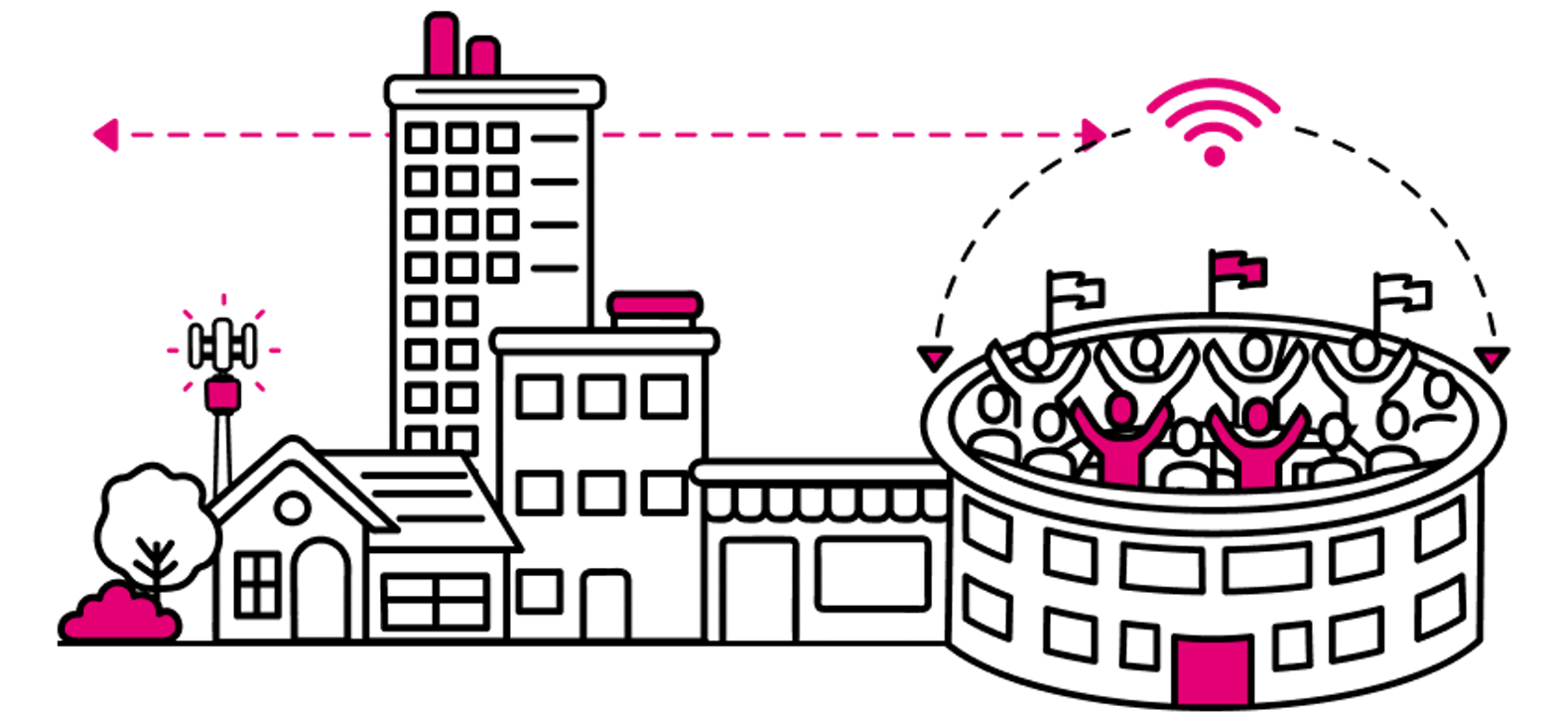
- Coverage refers to the geographic area where the network is available.
- Capacity is the amount of traffic the network can handle at once.
- Together, coverage and capacity determine whether a video call connects, a VR game renders smoothly, or reliable bandwidth is available to someone working from home.
Any network has a finite amount of capacity. Just like traffic congestion on a road, when too much information is being transmitted over a wireless network at once, the speed of the network slows down.
Improving both coverage and capacity requires denser wireless networks. That doesn’t always involve building new cell towers or macro sites. Thanks to innovations like small cells, T-Mobile can add capacity in high-demand areas, delivering faster, more reliable service for everyone.
## 5G versus 4G LTE.
Like 4G before it, 5G uses spectrum, or radio waves, to transmit data at safe, regulated levels. Only 5G does it better. The difference? 5G networks use a mix of radio frequencies to balance performance, coverage, and capacity.
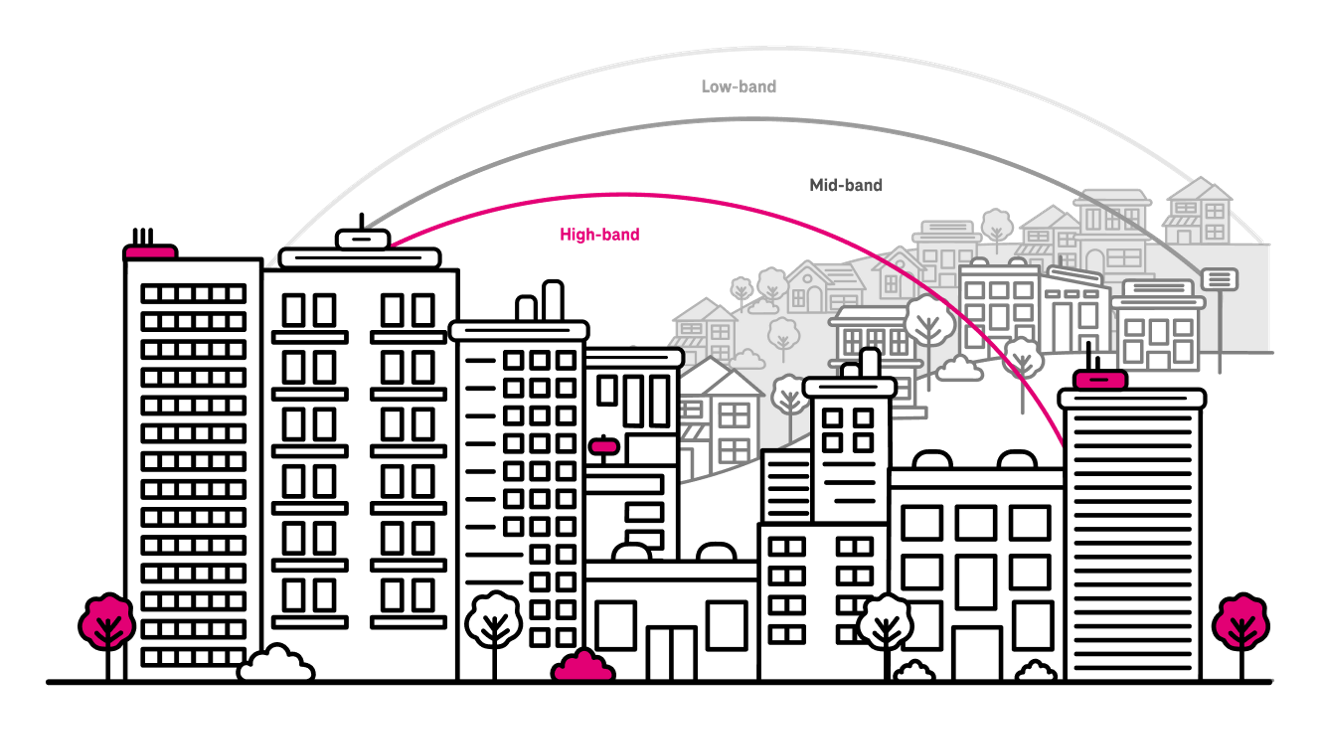
It's this multi-spectrum technology that makes the shift from 4G to 5G a game changer for everyone.
__Speed.__ 5G is up to 10 times faster—that means less buffering of your favorite show.
__Connectivity.__ 5G can connect more devices at once and deliver better service to all communities.
__Security.__ 5G keeps your data safer with stronger encryption and security features.
__Efficiency.__ 5G consumes much less energy, making it better for you and the environment.
What's next? 6G, of course. T-Mobile is currently working with the Al-RAN Alliance to help guide the future of 6G by combining wireless technologies with Al. With 6G, network planning and performance will continue to evolve in ways that benefit us all.
## Cell towers are only one piece of wireless networks.
It’s not just about building more infrastructure. Meeting your community’s wireless demands requires the right infrastructure in the right places.

## Macro antenna sites. [Macro antenna sites.](https://www.t-mobile.com) Macro antenna sites.
Cellular antennas are installed on rooftops, building facades, and tall monopoles to provide coverage over wide areas and long distances. The higher they're installed, the further their signal can travel, reducing the total number of sites needed to cover a region.
## Macro antenna sites.
## Small cells. [Small cells.](https://www.t-mobile.com) Small cells.
Small cells are compact, low-power antennas that enhance network performance in busy areas. Installed on streetlights, utility poles, or inside large buildings, they add extra capacity and help ensure reliable service in crowded or high-usage zones.
## Small cells.
## DAS technologies. [DAS technologies.](https://www.t-mobile.com) DAS technologies.
A distributed antenna system (DAS) is a network made up of a base station connected to a group of antennas installed in indoor or outdoor locations to improve wireless coverage and capacity. DAS deployments in public spaces often require permits.
## DAS technologies.
## Complying with state and local regulations.
As we continue to expand our nationwide 5G network across the country, T-Mobile partners with local communities to ensure full compliance with all applicable federal, state, and local laws, ordinances, and regulatory requirements.
## Hello! Want to stay logged in?
To keep your accounts safe, you'll be automatically logged out in:
Yes, stay logged in
No, log me out
## Share your screen while on a call or in store
__Get guided support from an Expert in real time__
- For your security, personal info, tabs, and notifications are automatically hidden.
- You can stop screen sharing at any time.
- Experts can only see what’s on T-Mobile.com.
- Don’t use screen share while driving or in any situation where it's unsafe to focus on your screen.
By clicking 'Accept and continue,' you are consenting to allow the Expert to view your screen for assisted navigation. This session may be recorded. To learn more, please visit the
[__T-Mobile Privacy Notice__](https://www.t-mobile.com/privacy-center/privacy-notices/t-mobile-privacy-notice).
Accept and continue
No thanks
__Next:__ Generate a code to share with your Expert
## Share this code with your Expert
code
Once your code has been successfully entered by your Expert, this window will close and continue to the session.
## Allow screen sharing with your Expert?
Personal and sensitive data is hidden for your security and privacy.
Allow
Don’t allow
## End your session?
Ending your session will stop sharing your screen, but will not end your call.
End session
Continue session
## Your session has ended
Your screen is no longer being shared with your Expert.
OK
Share again
## You are already in an active session
OK
## Your code has expired
Generate a new one to share with your Expert.
Generate new code
## Follow T-Mobile
- ## How mobile works
How mobile works
- [Innovation](https://www.t-mobile.com/how-mobile-works/innovation)
- [Network education](https://www.t-mobile.com/how-mobile-works/network-education)
- [5G community benefits](https://www.t-mobile.com/how-mobile-works/5g-community-benefits#INTNAV=tNav:5GCommunityBenefits)
- [Cell site permitting](https://www.t-mobile.com/how-mobile-works/cell-site-permitting)
- [Indoor coverage](https://www.t-mobile.com/how-mobile-works/indoor-coverage)
[](https://www.t-mobile.com/)
- [Instagram](https://www.instagram.com/tmobile/)
- [Facebook](https://www.facebook.com/TMobile)
- [X](https://twitter.com/TMobile)
- [You Tube](https://www.youtube.com/user/TMobile/custom)
- [About](https://www.t-mobile.com/our-story)
- [Investor relations](https://investor.t-mobile.com?INTNAV=fNav%3AAInvestorRelations)
- [Press](https://www.t-mobile.com/news)
- [Careers](https://careers.t-mobile.com?INTNAV=fNav%3ACareers)
- [Deutsche Telekom](https://www.telekom.com/en?INTNAV=fNav%3ADeutscheTelekom)
- [Puerto Rico](https://www.t-mobilepr.com/?INTNAV=fNav%3APuertoRico)
- [Privacy Notice](https://www.t-mobile.com/privacy-center/privacy-notices/t-mobile-privacy-notice)
- [Trust Center](https://security.t-mobile.com/?INTNAV=fNav%3ATrustCenter)
- [Privacy Center](https://www.t-mobile.com/privacy-center)
- [Consumer information](https://www.t-mobile.com/responsibility/consumer-info)
- [Public safety/911](https://www.t-mobile.com/responsibility/consumer-info/safety/9-1-1)
- [Terms & conditions](https://www.t-mobile.com/responsibility/legal/terms-and-conditions)
- [Terms of use](https://www.t-mobile.com/responsibility/consumer-info/policies/terms-of-use)
- [Accessibility](https://www.t-mobile.com/responsibility/consumer-info/accessibility-policy)
- [Open Internet](https://www.t-mobile.com/responsibility/consumer-info/policies/internet-service)
- [Do Not Sell or Share My Personal Information](https://www.t-mobile.com)
- [Licenses & Patents](https://www.t-mobile.com/responsibility/legal/licenses-and-patents)
- [Consumer Health Data Privacy Notice](https://www.t-mobile.com/privacy-center/privacy-notices/t-mobile-privacy-notice.html?INTNAV=fNav%3AConsumerHealthDataPrivacyNotice#health-data-privacy-notice)
- T-Mobile, the T logo, Magenta and the magenta color are registered trademarks of Deutsche Telekom AG.
- [Instagram](https://www.instagram.com/tmobile/)
- [Facebook](https://www.facebook.com/TMobile)
- [X](https://twitter.com/TMobile)
- [You Tube](https://www.youtube.com/user/TMobile/custom)
© 2026 T‑Mobile USA, Inc.

## Stay up to date with notifications
Get the latest from T-Mobile when you’re using the web. You can opt out any time.
Allow notifications Don't allow

## Get the latest from T-Mobile
Stay up to date with notifications - including offers just for you
Allow notifications Don't allow notifications
## Macro antenna sites.
## Small cells.
## DAS technologies.

## Stay up to date with notifications
Get the latest from T-Mobile when you’re using the web. You can opt out any time.
Allow notifications Don't allow

## Get the latest from T-Mobile
Stay up to date with notifications - including offers just for you
Allow notifications Don't allow notifications