[Skip to content](https://www.t-mobile.com/dialed-in/devices/headphones-vs-earbuds-buying-guide#maincontent)

Hey, looks like you need help finding something. I am here to chat if you have any questions
Skip to main content Skip to footer
[Wireless](https://www.t-mobile.com/)
[Business](https://www.t-mobile.com/business)
[Prepaid](https://prepaid.t-mobile.com/home)
[Internet](https://www.t-mobile.com/home-internet)
[](https://www.t-mobile.com)
Log in
[Plans](https://www.t-mobile.com/cell-phone-plans)
[Unlimited Phone Plans](https://www.t-mobile.com/cell-phone-plans)[Unlimited Age 55+](https://www.t-mobile.com/cell-phone-plans/unlimited-55-senior-discount-plans)[Military & Veterans](https://www.t-mobile.com/cell-phone-plans/military-discount-plans)[First Responder](https://www.t-mobile.com/cell-phone-plans/first-responder-discounts)[College Students](https://www.t-mobile.com/cell-phone-plans/student-discounts)[5G Home Internet Plans](https://www.t-mobile.com/home-internet/plans)[Fiber Internet Plans](https://www.t-mobile.com/home-internet/fiber)[Watch & Tablet Plans](https://www.t-mobile.com/cell-phone-plans/affordable-data-plans)[Prepaid Phone Plans](https://prepaid.t-mobile.com/prepaid-plans)[Business Phone Plans](https://www.t-mobile.com/business/wireless-business-plans)
[Phones & devices](https://www.t-mobile.com/cell-phones)
[Cell phones](https://www.t-mobile.com/cell-phones)[5G phones](https://www.t-mobile.com/5g/phones)[Tablets](https://www.t-mobile.com/tablets)[Smartwatches](https://www.t-mobile.com/smart-watches)[Hotspots & more](https://www.t-mobile.com/hotspots-iot-connected-devices)[Accessories](https://www.t-mobile.com/accessories)[Bring your own device](https://www.t-mobile.com/resources/bring-your-own-phone)[Tech Gift Ideas](https://www.t-mobile.com/devices/tech-gifts)
[Deals](https://www.t-mobile.com/offers)
[See all deals](https://www.t-mobile.com/offers)[Apple](https://www.t-mobile.com/offers/apple-iphone-deals)[Samsung](https://www.t-mobile.com/offers/samsung-phone-deals)[Motorola](https://www.t-mobile.com/offers/motorola-phone-deals)[Google](https://www.t-mobile.com/offers/google-phone-deals)[Revvl](https://www.t-mobile.com/offers/t-mobile-revvl-phone-deals)[Free & Zero Down Phones](https://www.t-mobile.com/switch/free-cell-phone-with-plan)
[Coverage](https://www.t-mobile.com/coverage/network)
[Our network](https://www.t-mobile.com/coverage/network)[4G & 5G Coverage map](https://www.t-mobile.com/coverage/coverage-map)[What is 5G](https://www.t-mobile.com/5g)[Satellite Phone Service](https://www.t-mobile.com/coverage/satellite-phone-service)[Rural & Small Towns](https://www.t-mobile.com/coverage/small-towns-rural-areas)[Try our network](https://www.t-mobile.com/offers/free-trial)[5G news](https://www.t-mobile.com/news/category/network)[Home Internet](https://www.t-mobile.com/home-internet/eligibility)
[Join Us](https://www.t-mobile.com/resources/how-to-join-us)
[How to switch](https://www.t-mobile.com/resources/how-to-join-us)[Bring your own phone](https://www.t-mobile.com/resources/bring-your-own-phone)[Keep your number](https://www.t-mobile.com/resources/keep-your-number)[Keep & switch](https://www.t-mobile.com/switch/keep-phone-switch-from-verizon-or-att)[Benefits](https://www.t-mobile.com/benefits)[Find your reason](https://www.t-mobile.com/membership)[T-Mobile Tuesdays](https://www.t-mobile.com/offers/t-mobile-tuesdays)
[Contact & support](https://www.t-mobile.com/contact-us)
[](https://www.t-mobile.com)[1-800-T-MOBILE](tel:1-800-866-2453)[Check order status](https://www.t-mobile.com/orders/check-order)[Help & support](https://www.t-mobile.com/support)[](https://www.t-mobile.com)
[Cart](https://www.t-mobile.com/cart)
Search
- POPULAR
[Search](javascript:void%280%29)
My account
more from T-Mobile
- [Wireless](https://www.t-mobile.com/)
- [Business](https://www.t-mobile.com/business)
- [Prepaid](https://prepaid.t-mobile.com/home)
- [Internet](https://www.t-mobile.com/home-internet)
Legal
- [Privacy Policy](https://www.t-mobile.com/privacy-center/our-practices/privacy-policy)
- [Do Not Sell My Personal Information](javascript:void%280%29)
- [Privacy Center](https://www.t-mobile.com/privacy-center)
[Log in](https://www.t-mobile.com)
[Bill pay](https://www.t-mobile.com/signin?state=eyJpbnRlbnQiOiJQYXltZW50IiwiYm9va21hcmtVcmwiOiJodHRwczovL215LnQtbW9iaWxlLmNvbS9vbmV0aW1lcGF5bWVudCJ9) [Add a line](https://www.t-mobile.com/commerce/device-intent) [Upgrade](https://www.t-mobile.com/purchase/shop) [Check order status](https://www.t-mobile.com/orders/check-order) [Ask the Community](https://www.t-mobile.com/community)
[Dialed In](https://www.t-mobile.com/dialed-in)
- [All Blogs](https://www.t-mobile.com/dialed-in/latest)
- [Devices](https://www.t-mobile.com/dialed-in/category/devices)
- [Accessories](https://www.t-mobile.com/dialed-in/category/accessories)
- [Tips & Tricks](https://www.t-mobile.com/dialed-in/category/tips-tricks)
- [Wireless 101](https://www.t-mobile.com/dialed-in/category/wireless)
- [The Signal](https://www.t-mobile.com/home-internet/the-signal/)
- [Newsroom](https://www.t-mobile.com/news)
- [All Blogs](https://www.t-mobile.com/dialed-in/latest)
- [Devices](https://www.t-mobile.com/dialed-in/category/devices)
- [Accessories](https://www.t-mobile.com/dialed-in/category/accessories)
- [Tips & Tricks](https://www.t-mobile.com/dialed-in/category/tips-tricks)
- [Wireless 101](https://www.t-mobile.com/dialed-in/category/wireless)
- [The Signal](https://www.t-mobile.com/home-internet/the-signal/)
- [Newsroom](https://www.t-mobile.com/news)
1. [Dialed In](https://www.t-mobile.com/dialed-in)
2. Category:[Devices](https://www.t-mobile.com/dialed-in/category/devices)
[DevicesCategory](https://www.t-mobile.com/dialed-in/category/devices)
# Headphones vs. Earbuds Buying Guide: Find the Right Fit for You
Published: February 3, 2026
|11 min read
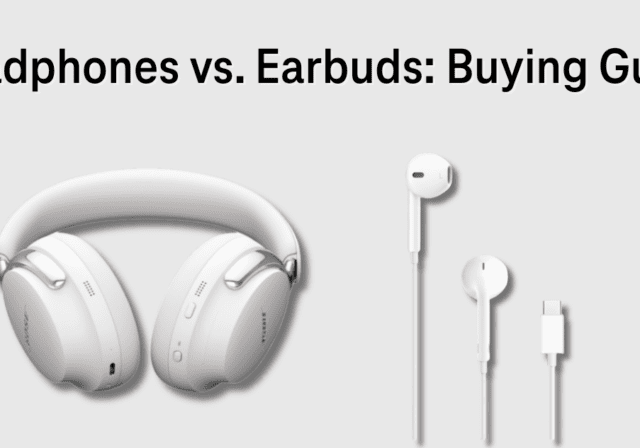
Choosing between [headphones and earbuds](https://www.t-mobile.com/accessories/category/headphones) comes down to how, where, and how long you listen. Over-ear and on-ear headphones typically deliver bigger, more immersive sound and long-session comfort, while in-ear and open-ear earbuds excel at portability, convenience, and workout-friendly stability.
- Share "Headphones vs. Earbuds Buying Guide: Find the Right Fit for You" on X
- Share "Headphones vs. Earbuds Buying Guide: Find the Right Fit for You" on Facebook
- Share "Headphones vs. Earbuds Buying Guide: Find the Right Fit for You" on LinkedIn
In this article, we’ll break down the strengths and trade‑offs of headphones and earbuds, evaluating sound quality, noise control, comfort, portability, and more. Then, we’ll make headphones vs. earbuds recommendations for work from home (WFH), fitness, on‑the‑go commuting and travel, and budget buys – so you can pick with confidence.
*\*This comparison guide was created by T-Mobile to help you explore accessories in our store. The opinions expressed here reflect our editorial perspective based on publicly available features, specifications, and articles.*
[SHOP T-MOBILE HEADPHONES & EARBUDS](https://www.t-mobile.com/accessories/category/headphones)
## Key takeaways: Headphones vs. earbuds
Use these quick hits to orient your decision before diving into the details.
- __Headphones__ typically offer richer, deeper audio quality and comfort for extended use, but are bulkier and less suitable for intense workouts.
- __Earbuds__ are ultra-portable and better for active use, though their audio quality can depend heavily on achieving a good ear seal.
- Earbuds win for pocketable portability on the go, while over‑ear headphones tend to feel more comfortable for long, stationary listening sessions but can be bulkier and warmer.
## How to choose between headphones vs. earbuds: Quick decision flow
Use this quick flow to narrow your shortlist, then test‑fit your top contenders to confirm comfort and seal. Answer each step honestly for your lifestyle; there’s no wrong choice, only the right fit for your priorities.
1. __Start with your primary use:__ WFH, fitness, commute/travel, or casual listening.
2. __Decide on awareness:__ Is top‑tier ANC critical, or do you prefer open/transparency for safety?
3. __Consider session length and climate:__ Over‑ears suit long, stationary listening; earbuds shine for short, mobile bursts and hot weather.
4. __Set your budget range__ (Under $50, $50–$100, $100–$200, $200+).
5. __Match form factor to your needs:__ over‑ear/on‑ear for immersion and comfort; in‑ear/open‑ear for portability and workouts.
6. __Shortlist 2–3 models__ __and test__ for 10–15 minutes to check seal, comfort, controls, and call quality.
[SHOP T-MOBILE ACCESSORIES](https://www.t-mobile.com/accessories/category/headphones)
## Shop headphones and earbuds based on your lifestyle
| Use case | Form factor | Model | Price band | Why it fits |
|-----------------|-------------------------|---------------------------------------|------------|------------------------------------------------------------------------|
| Budget | In-ear wired | Apple EarPods | Under $25 | Reliable wired option with simple plug‑and‑play convenience. |
| WFH | Over‑ear wireless | Beats Studio Pro Wireless Headphones | $200+ | Strong ANC and cushioned comfort for long focus sessions. |
| WFH | Over‑ear wireless | Apple AirPods Max (USB‑C) | $200+ | Premium build, comfortable fit, and immersive listening for deep work. |
| WFH | Over‑ear wireless | Sony WH‑1000XM6 Headphones | $200+ | Flagship ANC with customizable sound for busy home offices. |
| On-the-go | On‑ear wireless | JBL Tune 670NC Wireless Headphones | $50–$100 | Compact, foldable design with everyday ANC for commuting. |
| On-the-go | True wireless | Samsung Buds3 FE | $100–$200 | Pocketable case, quick pairing, and balanced sound for daily carry. |
| On-the-go | True wireless | Apple AirPods Pro (3rd Gen) | $200+ | Excellent convenience with ANC/transparency for travel and calls. |
| Fitness | True wireless (earhook) | Beats Powerbeats Fit | $100–$200 | Secure earhooks and sweat‑ready design for runs and HIIT. |
| Fitness | Open‑ear earbuds | Bose Ultra Open Earbuds | $200+ | Awareness‑first fit with immersive listening while you move. |
| Premium earbuds | True wireless | Samsung Galaxy Buds3 Pro | $200+ | Feature‑rich buds with versatile ANC and awareness modes. |
| Budget | In‑ear wireless | Beats Flex All‑Day Wireless Earphones | $50–$100 | Affordable, lightweight, and easy to wear for everyday listening. |
## Headphones vs. earbuds: What’s the real difference?
__Headphones__ come in two primary styles: on-ear and over-ear. Both feature larger drivers that produce fuller audio with deeper bass and better spatial sound compared to earbuds. Cushioned pads and effective passive isolation paired with Active Noise Cancellation (ANC) also help headphones perform well in noisy environments.
__Earbuds__, on the other hand, are smaller, highly portable devices that fit inside or just outside your ear canal. Their compact design makes them ideal for workouts, commuting, and casual use, but the audio experience heavily depends on the quality of the earbud seal.
### 5 Advantages of headphones
1. Bigger drivers offer stronger dynamics, richer bass, and wider soundstage.
2. Superior passive isolation and ANC to effectively block external noise.
3. Comfortable cushioned headbands and ear pads suitable for long listening sessions.
4. Often more durable with repairability options.
5. Richer features in premium models (multipoint connectivity, spatial audio).
1. Flagship over‑ears – think lines like [Apple AirPods Max](https://www.t-mobile.com/accessory/apple-airpods-max-usb-c?sku=195949544170), [Sony WH‑1000XM6](https://www.t-mobile.com/accessory/sony-wh-1000xm6-headphones?sku=610214688767), or [Beats Studio Pro](https://www.t-mobile.com/accessory/beats-studio-pro-wireless-headphones?sku=194253715092) – also tend to offer richer feature sets for multipoint, spatial modes, and customization.
### 4 Disadvantages of headphones
1. Bulky and less portable, inconvenient for quick errands or crowded commutes.
2. Can feel heavy or warm during extended use, particularly in hot weather.
3. Less suited for vigorous exercise due to shifting and moisture sensitivity.
4. Typically more expensive than earbuds.
### 4 Advantages of earbuds
1. Highly portable and easily pocketable with charging cases.
2. Proximity to the ear canal can deliver excellent clarity and strong ANC/transparency modes.
3. Discreet and ideal for commuting, video calls, and quick everyday use.
4. Designed for secure fit and sweat resistance, suitable for workouts.
- True wireless lines like [Apple AirPods Pro](https://www.t-mobile.com/accessory/apple-airpods-pro-3?sku=195950543698), [Samsung Galaxy Buds3 Pro](https://www.t-mobile.com/accessory/samsung-galaxy-buds3-pro?sku=887276868141), [Samsung Buds3 FE](https://www.t-mobile.com/accessory/samsung-buds3-fe?sku=198957213090), and open‑ear designs such as [Bose Ultra Open Earbuds](https://www.t-mobile.com/accessory/bose-ultra-open-earbuds?sku=610214681973) emphasize convenience features, rapid pairing, and on‑the‑go charging with compact cases.
### 4 Disadvantages of earbuds
1. Smaller drivers mean less immersive soundstage and less bass impact.
2. Audio quality heavily depends on achieving a good seal.
3. Fit-dependent comfort; potential ear fatigue over extended use.
4. Shorter battery life per charge compared to headphones (charging cases extend usability).
## Sound quality: Headphones vs. earbuds
For pure immersion, headphones usually excel due to larger drivers, deeper bass, and a wider soundstage, enhancing orchestral music, cinematic experiences, and gaming. Earbuds have rapidly improved with advanced ANC and better seals that boost clarity and bass, but headphones like the [Apple AirPods Max](https://www.t-mobile.com/accessory/apple-airpods-max-usb-c?sku=195949544170) or [Sony WH-1000XM6](https://www.t-mobile.com/accessory/sony-wh-1000xm6-headphones?sku=610214688767) generally provide a more enveloping experience. To optimize audio quality in either type, ensure a good fit and explore EQ settings.
## Headphones vs. earbuds picks by lifestyle: WFH, fitness, on‑the‑go, budget
- __WFH:__ Choose comfort and ANC first. Over‑ears excel for long meetings and focus time, with easy switching between devices and strong mics for calls.
- __Fitness:__ Prioritize a secure fit and sweat resistance. Hooks or wings keep earbuds stable; open‑ear designs balance audio with awareness.
- __On‑the‑go:__ Small cases and quick pairing rule. Earbuds slip into pockets, yet compact on‑ears can be compelling for commuters who prefer cups over tips.
- __Budget:__ Value and reliability matter most. Simple wired or affordable wireless options cover calls, podcasts, and playlists without overspending.
- __Awareness:__ If you move through busy streets, consider open‑ear earbuds that keep you connected to your surroundings while adding spatial or immersive modes.
- __Try before you decide:__ Comfort and seal vary by person. Shortlist two or three models and test for 10–15 minutes to confirm fit, sound, and controls.
### On-the-go: portability and comfort while traveling
For the smallest carry, earbuds are hard to beat. Pocketable charging cases make them ideal for commuting, airport lines, and short listening sessions, with fast charging adding extra convenience.
For long flights or train rides, over-ear headphones often feel more comfortable and deliver stronger noise cancellation. Models like [Apple AirPods Max](https://www.t-mobile.com/accessory/apple-airpods-max-usb-c?sku=195949544170) and [Beats Studio Pro](https://www.t-mobile.com/accessory/beats-studio-pro-wireless-headphones?sku=194253715092) shine here, though they take up real bag space and can feel warm over time.
On-ear options, such as [JBL Tune 670NC,](https://www.t-mobile.com/accessory/jbl-tune-670nc-wireless-on-ear-headphones?sku=SUPM58301) split the difference for travel: lighter frames, foldable designs, and better airflow than over-ears, while still outperforming most earbuds in battery life. Earbuds like [Samsung Buds3 FE](https://www.t-mobile.com/accessory/samsung-buds3-fe?sku=198957213090) remain the easiest to stash and deploy, but tip fit and seal matter if you’re wearing them for several hours straight.
__For on-the-go moments and travel:__
- Choose earbuds for ultra-light packing and frequent transitions
- Choose over-ears for long flights and maximum noise reduction
- Consider on-ear headphones for carry-on efficiency with better comfort than earbuds
### Exercise and active use: Headphones vs. earbuds for exercise
For exercise and active use, earbuds are usually the better option thanks to secure fits, sweat resistance, and stability during runs or HIIT. Open‑ear designs help maintain awareness outdoors, while sealed in‑ear models isolate better in the gym.
Headphones can work for light cardio or lifting but may shift during intense movement, which is why purpose‑built options like [Beats Powerbeats Fit,](https://www.t-mobile.com/accessory/beats-powerbeats-fit?sku=195950384512) [Bose Ultra Open Earbuds,](https://www.t-mobile.com/accessory/bose-ultra-open-earbuds?sku=610214681973) or [Samsung Galaxy Buds3 Pro](https://www.t-mobile.com/accessory/samsung-galaxy-buds3-pro?sku=887276868141) are better suited for active lifestyles that demand stability, awareness, and quick pairing.
__For your workouts:__
- Look for ear hooks/wings for runs and HIIT stability
- Check water/sweat resistance ratings to protect your investment
- Pick open‑ear if awareness matters outdoors; go sealed for isolation in gyms
- Test fit at rest and in motion – jump, jog in place, and do a few squats
### Work from home: Focus, calls, and all-day wear
For work from home, comfort and call quality are key. Over‑ear headphones are often the best fit, offering cushioned ear cups, a stable fit, strong noise cancellation, and multipoint Bluetooth for easy switching between devices. Earbuds can still work well for shorter sessions or more mobile days, but extended wear may cause fatigue, even though newer designs with pressure‑relief vents and improved transparency make them more practical for hybrid schedules.
__If you’re on video calls all day, prioritize:__
- Clear mic performance and wind/noise reduction
- Comfortable fit for 4–8 hour stretches
- Reliable multipoint pairing for work devices
Over-ears tend to win for desk-based focus, while earbuds suit lighter, more mobile workdays.
### Casual listening: Everyday music, podcasts, and downtime
For casual listening, your choice depends on convenience and preference. Earbuds are great for quick listening, podcasts, or daily errands, offering transparency modes for easy awareness. Headphones are better if you value richer sound, deeper bass, and a more immersive experience for relaxing at home, watching videos, or enjoying detailed albums.
__If casual listening is your primary use:__
- Pick earbuds for grab-and-go simplicity
- Pick headphones if sound quality and comfort matter more than size
- Look for customizable EQ and awareness modes to adapt to different moods
Both can work beautifully here. It’s less about specs and more about how (and how often) you listen.
## FAQs about headphones and earbuds
__Which should I choose for the best overall sound quality, headphones or earbuds?__
Most listeners find over‑ear headphones deliver the widest soundstage and deepest, most controlled bass. Premium earbuds have improved dramatically, and a tight seal plus good ANC narrows the gap, but physics favor over‑ears for immersion.
__What’s better for workouts: headphones or earbuds?__
Earbuds are generally better. Look for secure hooks or wings and sweat resistance for stability and durability. Open‑ear designs maximize awareness outdoors. Headphones can slip during vigorous movement and run warmer.
__How do comfort and portability compare for commuting and long sessions?__
Earbuds win for pocket-ability and quick on/off use during commutes. For long, stationary sessions, over‑ear headphones often feel more comfortable due to cushioned pads and no in‑ear pressure, though they’re bulkier to carry.
__How loud is safe for headphones and earbuds?__
Safe listening habits apply to both headphones and earbuds. Keep volume moderate, take breaks during long sessions, and favor good isolation/ANC over cranking volume in noisy spaces.
__Should I use ANC or transparency mode for WFH?__
Active noise cancellation (ANC) helps reduce distractions, while transparency keeps you aware of doorbells and household needs. For full‑time remote work, many people pair strong ANC over‑ears with quick‑toggle transparency for moments of awareness.
__What about mic quality and battery life?__
Built‑in mics are convenient for calls, but dedicated boom mics still win for voice clarity. Battery life varies by class: over‑ears can run for days of typical use per charge, while true wireless earbuds rely on case top‑ups for all‑day coverage. Across the market – from value picks like [Apple EarPods](https://www.t-mobile.com/accessory/apple-earpods-usb-c?sku=195949776212) to premium over‑ears like Sonos Ace – expect trade‑offs between portability, isolation, and runtime.
__Expert tip:__ Choose the form factor that solves your biggest problem – immersion, portability, or awareness – then optimize fit and seal before judging sound.
__You may also be interested in:__
[https://www.t-mobile.com/dialed-in/devices/best-travel-headphones](https://www.t-mobile.com/dialed-in/devices/best-travel-headphones)
[https://www.t-mobile.com/dialed-in/accessories/gifts-for-music-lovers](https://www.t-mobile.com/dialed-in/accessories/gifts-for-music-lovers)
[https://www.t-mobile.com/dialed-in/accessories/best-workout-headphones-earbuds](https://www.t-mobile.com/dialed-in/accessories/best-workout-headphones-earbuds)
Tags
- [Audio](https://www.t-mobile.com/dialed-in/archive/audio)
- [Fitness Accessories](https://www.t-mobile.com/dialed-in/archive/fitness-accessories)
## Related Articles
NEW
[Read More](https://www.t-mobile.com/dialed-in/devices/compare-samsung-galaxy-flip-phones)
[](https://www.t-mobile.com/dialed-in/devices/compare-samsung-galaxy-flip-phones)
[Devices](https://www.t-mobile.com/dialed-in/category/devices)
## [Compare Samsung Galaxy Flip Phones](https://www.t-mobile.com/dialed-in/devices/compare-samsung-galaxy-flip-phones)
September 21, 2026
NEW
[Read More](https://www.t-mobile.com/dialed-in/devices/tablet-vs-laptop-buying-guide)
[](https://www.t-mobile.com/dialed-in/devices/tablet-vs-laptop-buying-guide)
[Devices](https://www.t-mobile.com/dialed-in/category/devices)
## [Tablet vs. Laptop: How to Choose the Right Device in 2026](https://www.t-mobile.com/dialed-in/devices/tablet-vs-laptop-buying-guide)
October 1, 2026
NEW
[Read More](https://www.t-mobile.com/dialed-in/devices/signs-to-upgrade-phone)
[](https://www.t-mobile.com/dialed-in/devices/signs-to-upgrade-phone)
[Devices](https://www.t-mobile.com/dialed-in/category/devices)
## [11 Signs It’s Time to Upgrade Your Phone](https://www.t-mobile.com/dialed-in/devices/signs-to-upgrade-phone)
September 29, 2026
### Get Connected with T-Mobile! Shop Now for your ideal phone.
[Shop now](https://www.t-mobile.com/cell-phones)
## Follow T-Mobile
- [](https://www.instagram.com/tmobile/)
- [](https://www.facebook.com/TMobile)
- [](https://twitter.com/TMobile)
- [](https://www.youtube.com/user/TMobile/custom)
[English](https://t-mobile.com)[Español](https://es.t-mobile.com)
Even more plans
Even more plans
- [Senior phone plans](https://www.t-mobile.com/cell-phone-plans/unlimited-55-senior-discount-plans)
- [International phone plans](https://www.t-mobile.com/cell-phone-plans/international-roaming-plans)
- [International passes](https://www.t-mobile.com/cell-phone-plans/international-roaming-plans/unlimited-calling-data-pass)
- [Home Internet plans](https://www.t-mobile.com/home-internet/plans)
- [Phone and internet bundles](https://www.t-mobile.com/cell-phone-plans/phone-home-internet-bundle)
- [Hotspot plans](https://www.t-mobile.com/cell-phone-plans/affordable-data-plans/hotspots)
- [Business phone plans](https://www.t-mobile.com/business/wireless-business-plans)
Shop devices by brand
Shop devices by brand
- [iPhones](https://www.t-mobile.com/cell-phones/brand/apple)
- [iPads](https://www.t-mobile.com/tablets/brand/apple)
- [Apple Watches](https://www.t-mobile.com/smart-watches/brand/apple)
- [Galaxy phones](https://www.t-mobile.com/cell-phones/brand/samsung)
- [Samsung tablets](https://www.t-mobile.com/tablets/brand/samsung)
- [Samsung watches](https://www.t-mobile.com/smart-watches/brand/samsung)
- [Motorola phones](https://www.t-mobile.com/cell-phones/brand/motorola)
- [Google Pixel phones](https://www.t-mobile.com/cell-phones/brand/google)
New featured cell phones
New featured cell phones
- [New Apple iPhone Duo](https://www.t-mobile.com/cell-phone/apple-iphone-duo)
- [New Apple iPhone 18 Pro](https://www.t-mobile.com/cell-phone/apple-iphone-18-pro)
- [New Apple iPhone 18 Pro Max](https://www.t-mobile.com/cell-phone/apple-iphone-18-pro-max)
- [New Samsung Galaxy Z Fold8](https://www.t-mobile.com/cell-phone/samsung-galaxy-z-fold8)
- [New Google Pixel 11](https://www.t-mobile.com/cell-phone/google-pixel-11)
New featured tablets, smartwatches & more
New featured tablets, smartwatches & more
- [Apple iPad Mini (A17 Pro)](https://www.t-mobile.com/tablet/apple-ipad-mini-a17-pro)
- [Apple iPad (A16)](https://www.t-mobile.com/tablet/apple-ipad-a16)
- [Apple Watch SE 3 40mm](https://www.t-mobile.com/smart-watch/apple-watch-se-3-40mm)
- [T-Mobile Revvl Tab 2](https://www.t-mobile.com/tablet/t-mobile-revvl-tab-2)
- [Samsung Galaxy Tab A11+ 5G](https://www.t-mobile.com/tablet/samsung-galaxy-tab-a11-plus-5g)
- [Samsung Galaxy Watch Ultra2](https://www.t-mobile.com/smart-watch/samsung-galaxy-watch-ultra2)
Helpful consumer guides
Helpful consumer guides
- [Dialed In](https://www.t-mobile.com/dialed-in)
- [Cell Phone BYOD Guide](https://www.t-mobile.com/dialed-in/devices/what-is-byod-bring-your-own-device)
- [The 6 Best Samsung Phones of 2026](https://www.t-mobile.com/dialed-in/devices/best-samsung-phones)
- [iPhone 18 Series: Specs, Price and Release Dates](https://www.t-mobile.com/dialed-in/devices/iphone-18-series-specs-features)
- [How Does Satellite Phone Service Work?](https://www.t-mobile.com/dialed-in/wireless/how-satellite-phone-service-works)
T-Mobile customer benefits
T-Mobile customer benefits
- [TV streaming deals](https://www.t-mobile.com/tv-streaming)
- [T-Mobile Tuesdays](https://www.t-mobile.com/offers/t-mobile-tuesdays)
- [In-flight wi-fi](https://www.t-mobile.com/benefits/travel/in-flight-wifi)
- [Refer-a-Friend](https://referral.t-mobile.com/)
- [Device protection plan](https://www.t-mobile.com/benefits/phone-protection-plans)
- [Protection 360® HomeTech](https://www.t-mobile.com/benefits/phone-protection-plans/p360-home-tech)
Switch to T-Mobile
Switch to T-Mobile
- [How to switch to T-Mobile](https://www.t-mobile.com/resources/how-to-join-us)
- [Try our 5G network](https://www.t-mobile.com/offers/free-trial)
- [Bring your own device](https://www.t-mobile.com/resources/bring-your-own-phone)
- [Switch to T-Mobile from Verizon or AT&T](https://www.t-mobile.com/switch/keep-phone-switch-from-verizon-or-att)
- [Family freedom deal](https://www.t-mobile.com/switch/pay-off-carrier-etf-phone-deal)
- [Cell phone trade-in](https://www.t-mobile.com/devices/phone-trade-in)
Additional support
Additional support
- [View return policy](https://www.t-mobile.com/responsibility/legal/return-policy)
- [Contact us](https://www.t-mobile.com/contact-us)
- [Billing](https://www.t-mobile.com/support/account/whats-impacting-your-bill)
- [Shipping & pickup options](https://www.t-mobile.com/customers/shipping-dates)
- [Free Internet for Students](https://www.t-mobile.com/brand/project-10-million)
- [Redeem a rebate](https://promotions.t-mobile.com/)
- [Domestic Violence Resources](https://www.t-mobile.com/support/account/keeping-customers-safe-connected)
About T-Mobile
About T-Mobile
- [Our Story](https://www.t-mobile.com/our-story)
- [T-Mobile careers](https://careers.t-mobile.com/)
- [Privacy Center](https://www.t-mobile.com/privacy-center)
- [Newsroom](https://www.t-mobile.com/news)
- [Corporate Responsibility](https://www.t-mobile.com/responsibility)
[](https://www.t-mobile.com)
- [About](https://www.t-mobile.com/our-story)
- [Investor relations](https://investor.t-mobile.com/default.aspx)
- [Press](https://www.t-mobile.com/news)
- [Careers](https://careers.t-mobile.com)
- [Deutsche Telekom](https://www.telekom.com/en)
- [Puerto Rico](https://www.t-mobilepr.com/)
- [Privacy Notice](https://www.t-mobile.com/privacy-center/privacy-notices/t-mobile-privacy-notice)
- [Trust Center](https://security.t-mobile.com/)
- [Privacy Center](https://www.t-mobile.com/privacy-center)
- [Consumer information](https://www.t-mobile.com/responsibility/consumer-info)
- [Public safety/911](https://www.t-mobile.com/responsibility/consumer-info/safety/9-1-1)
- [Terms & conditions](https://www.t-mobile.com/responsibility/legal/terms-and-conditions)
- [Terms of use](https://www.t-mobile.com/responsibility/consumer-info/policies/terms-of-use)
- [Accessibility](https://www.t-mobile.com/responsibility/consumer-info/accessibility-policy)
- [Open Internet](https://www.t-mobile.com/responsibility/consumer-info/policies/internet-service)
- [Do Not Sell or Share My Personal Information](javascript:void%280%29)
- [Licenses & Patents](https://www.t-mobile.com/responsibility/legal/licenses-and-patents)
- [Consumer Health Data Privacy Notice](https://www.t-mobile.com/privacy-center/privacy-notices/t-mobile-privacy-notice.html#health-data-privacy-notice)
- [T-Mobile, the T logo, Magenta and the magenta color are registered trademarks of Deutsche Telekom AG.](https://www.t-mobile.com)
- [](https://www.instagram.com/tmobile/)
- [](https://www.facebook.com/TMobile)
- [](https://twitter.com/TMobile)
- [](https://www.youtube.com/user/TMobile/custom)
© 2026 T‑Mobile USA, Inc.
Top